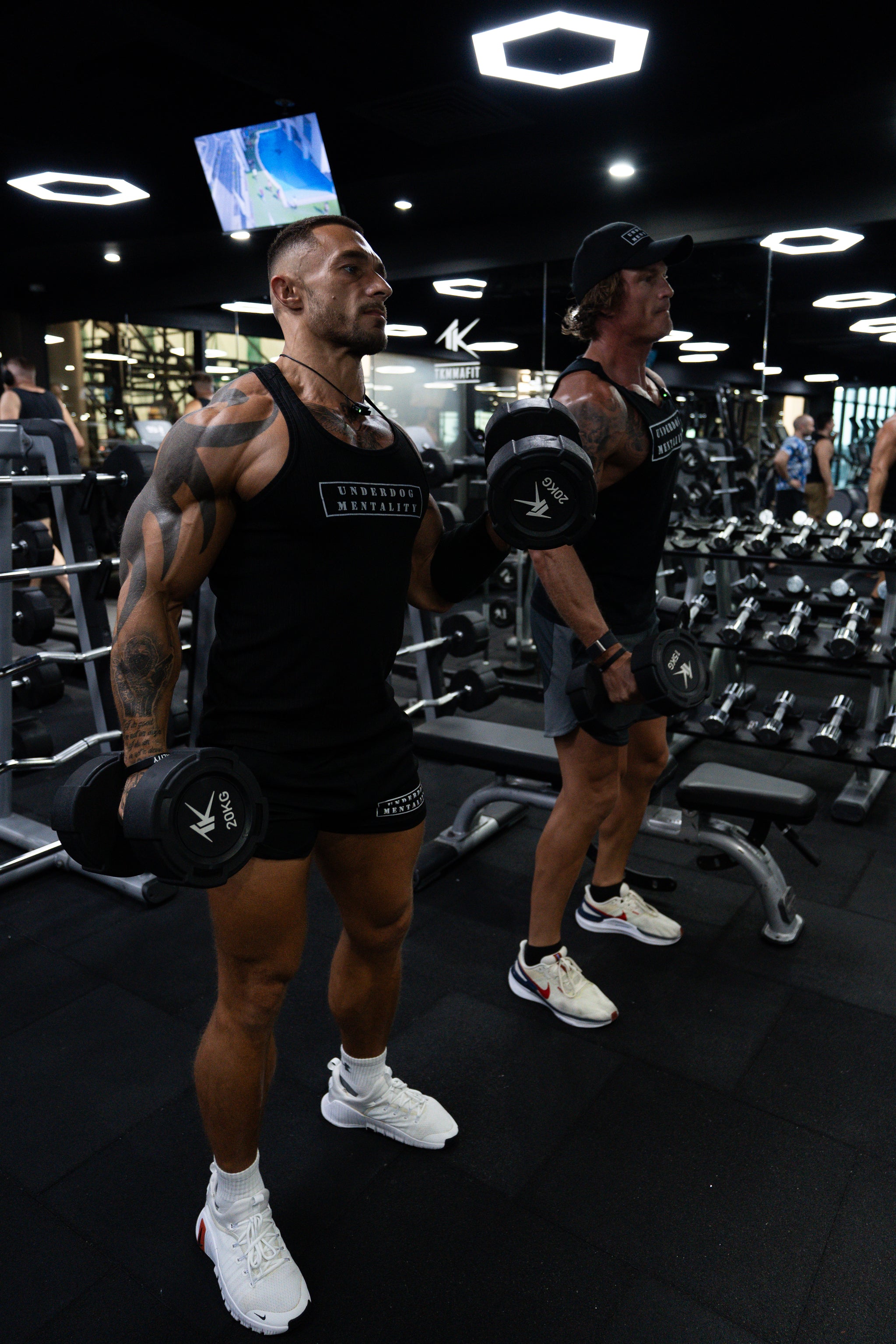
Resistance bands and free weights both build muscle effectively. A 2019 meta-analysis published in SAGE Open Medicine found that elastic resistance training promotes similar strength gains to conventional resistance training when matched for intensity. The main difference is that bands provide variable resistance (harder at peak contraction) while free weights provide constant resistance. The best choice depends on your training goals, available space, and budget.
Quick Comparison: Bands vs Weights
| Factor | Resistance Bands | Free Weights |
|---|---|---|
| Muscle Building | Effective (research-backed) | Gold standard |
| Cost | $25-$200 for full set | $500-$5,000+ for home gym |
| Portability | Fits in a backpack | Fixed location |
| Space Required | Minimal | Significant |
| Joint Stress | Lower (accommodating resistance) | Higher on heavy compounds |
| Progressive Overload | Limited by band tension | Unlimited (add plates) |
| Exercise Variety | Very high | Very high |
| Beginner Friendly | Excellent | Moderate (form required) |
| Max Strength Development | Limited beyond intermediate | Excellent |
The Science: Do Resistance Bands Actually Build Muscle?
Yes. Multiple peer-reviewed studies confirm bands build muscle:
- SAGE Open Medicine (2019): Meta-analysis showed elastic resistance training promotes comparable strength gains to conventional weight training
- Journal of Sports Science & Medicine (2019): Resistance band training increased muscle activation in the chest and triceps comparably to barbell bench press
- Frontiers in Physiology (2022): Band training produced similar hypertrophy to free weights in untrained individuals over 8 weeks
The key principle: Muscle growth requires progressive mechanical tension. Both bands and weights provide this — just differently.
How Resistance Band Tension Works
Bands create variable resistance — the tension increases as the band stretches. This means:
- Bottom of the movement: Lower resistance (easier)
- Top of the movement: Peak resistance (hardest)
This is called an ascending strength curve, and it matches how most pushing and pulling movements work naturally — you're strongest at lockout and weakest at the start.
War Bands advantage: Unlike standard bands where tension degrades over months of use, War Bands by Underdog Mentality use constant tension technology. The resistance level stays consistent from your first workout to your 500th.
When to Choose Resistance Bands
Bands are the better choice when:
- You're building a home gym on a budget — A full band set costs $50-$200 vs thousands for weights
- You travel frequently — Bands fit in a carry-on bag
- You're rehabbing an injury — Lower joint stress with accommodating resistance
- You want variety without bulk — One band set replaces dozens of dumbbell pairs
- You're a beginner — Bands are more forgiving with form
When to Choose Free Weights
Free weights are better when:
- You want maximum strength — Nothing replaces heavy barbell work for peak force development
- You're an intermediate/advanced lifter — Progressive overload is easier to track and implement
- You compete in powerlifting or Olympic lifting — Specificity matters
- You have space and budget — A proper rack, bar, and plates give unlimited progression
The Best Approach: Use Both
Most strength coaches recommend combining bands and weights. Here's how:
Bands + Weights Combinations:
- Banded squats/deadlifts — Add band resistance at the top for lockout power
- Band-assisted pull-ups — Use bands to build toward unassisted reps
- Band warmups → Heavy weights — Activate muscles with bands before heavy sets
- Travel days: Bands when you can't access a gym
Sample Weekly Split (Bands + Weights):
| Day | Training | Equipment |
|---|---|---|
| Monday | Heavy compounds (squat, bench, row) | Barbell + plates |
| Tuesday | Band accessory work (face pulls, lateral raises, curls) | Resistance bands |
| Wednesday | Rest | — |
| Thursday | Heavy compounds (deadlift, OHP, pull-ups) | Barbell + plates |
| Friday | Band conditioning + core | Resistance bands |
Choosing the Right Resistance Bands
Not all bands are equal. Here's what separates premium bands from cheap ones:
| Feature | Budget Bands ($15-30) | Premium Bands (War Bands, $149) |
|---|---|---|
| Tension consistency | Degrades within months | Constant tension over time |
| Snap resistance | Moderate | Military-grade tear resistance |
| Resistance range | 10-80 lbs typically | Up to 200 lbs combined |
| Material | Standard latex | Premium natural latex |
| Warranty | None or 30 days | Extended coverage |
"I've been through dozens of cheap band sets that snap or lose tension after a few weeks. The War Bands are unlike anything else on the market — the tension doesn't fade. That's why we built them." — Rafael Motloch, Underdog Mentality
Frequently Asked Questions
Can you build muscle with just resistance bands?
Yes. Research shows resistance bands produce comparable muscle growth to free weights, especially for beginners and intermediate lifters. For advanced lifters seeking maximum strength, bands work best as a supplement to heavy barbell training.
How much resistance do I need from bands?
For general fitness: 10-50 lbs per band. For strength training: bands that combine to 100-200 lbs. The War Bands set combines for up to 200 lbs of total resistance, covering everything from rehab to heavy compound movements.
Do resistance bands lose their stretch over time?
Standard latex bands lose 10-30% of their tension within 6-12 months of regular use. Premium bands like War Bands are designed with constant tension technology that maintains resistance levels significantly longer than standard alternatives.
Are resistance bands safe?
Yes, when used properly. Inspect bands for tears before each use, don't overstretch beyond the recommended range, and anchor them securely. Quality bands from reputable brands (not dollar-store bands) have much lower failure rates.
What exercises can you do with resistance bands?
Virtually any exercise: squats, deadlifts, chest press, rows, bicep curls, tricep extensions, lateral raises, face pulls, hip thrusts, leg curls, and hundreds more. A quality band set can replace an entire gym for most training goals.
The Bottom Line
Both resistance bands and free weights build muscle. The science is clear on this. If you're choosing between them:
- Budget or space limited? Start with bands — they deliver real results
- Want maximum strength? You need heavy free weights
- Best results overall? Combine both
For anyone investing in bands, don't waste money on sets that lose tension in months. The War Bands ($149) are built to maintain constant tension through thousands of workouts — it's the last set you'll need to buy.
About the Author: Rafael Motloch is the founder of Underdog Mentality, a fitness lifestyle brand with 10,000+ members. His War Bands resistance bands are rated "tier 1" quality by verified customers and built for athletes who demand gear that performs as hard as they do.